Decision Making
Decision-making is the anticipation of conditions occurring during the execution of a program and specified actions taken according to the conditions.
Decision structures evaluate multiple expressions, which produce TRUE or FALSE as the outcome. You need to determine which action to take and which statements to execute if the outcome is TRUE or FALSE otherwise.
Following is the general form of a typical decision making structure found in most of the programming languages −
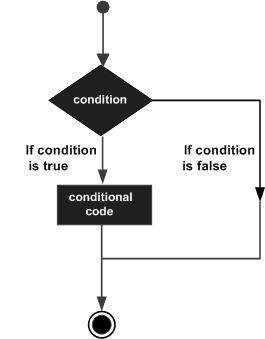
Spla programming language assumes any non-zero and non-null values as TRUE, and any zero or null values as FALSE value.
Spla programming language provides the following types of decision-making statements.
| Sr.No. | Statement & Description |
|---|---|
| 1 | if statements
An if statement consists of a boolean expression followed by one or more statements. |
| 2 | if...else statements
An if statement can be followed by an optional else statement, which executes when the boolean expression is FALSE. |
| 3 | nested if statements
You can use one if or else if statement inside another if or else if statement(s). |
Let us go through each decision-making statement quickly.
Single Statement Suites
If the suite of an if clause consists only of a single line, it may go on the same line as the header statement.
Example
Here is an example of a one-line if clause −
int var = 100;
??   var==100   :
   << 'Value of expression is 100';
<< 'Good bye!';
Output
When the above code is executed, it produces the following result −
Value of expression is 100
Good bye!
Spla - IF Statement
The IF statement is similar to that of other languages. The if statement contains a logical expression using which the data is compared and a decision is made based on the result of the comparison.
Syntax
?? expression:
   statement(s)
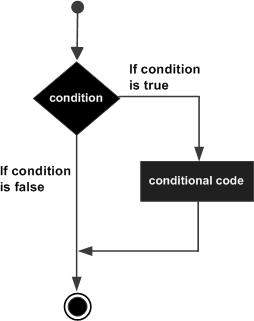
If the boolean expression evaluates to TRUE, then the block of statement(s) inside the if statement is executed. In Spla, statements in a block are uniformly indented after the : symbol. If boolean expression evaluates to FALSE, then the first set of code after the end of block is executed.
Flow Diagram
Example
int var1 = 100;
?? var1:
   << '1 - Got a true expression value';
   << var1;

int var2 = 0;
?? var2:
   << '2 - Got a true expression value';
   << var2;
<< 'Good bye!';
Output
When the above code is executed, it produces the following result −
1 - Got a true expression value
100
Good bye!
Spla - IF...ELSE IF...ELSE Statements
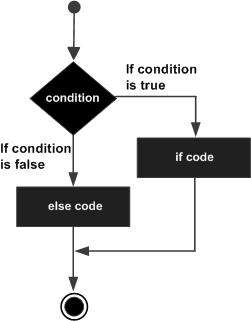
An else statement can be combined with an if statement. An else statement contains a block of code that executes if the conditional expression in the if statement resolves to 0 or a FALSE value.
The else statement is an optional statement and there could be at the most only one else statement following if.
Syntax
The syntax of the if...else statement is −
?? expression:
   statement(s);

//
   statement(s);
Flow Diagram
Example
int amount = 0;
<<'Enter amount: ';
>>amount;

?? amount<1000:
   discount = amount*0.05;
   <<'Discount'+discount;
//
   discount = amount*0.10;
   <<'Discount'+discount;

<<'Net payable:'+amount-discount;
Output
In the above example, discount is calculated on the input amount. Rate of discount is 5%, if the amount is less than 1000, and 10% if it is above 10000. When the above code is executed, it produces the following result −
Enter amount: 600
Discount 30.0
Net payable: 570.0

Enter amount: 1200
Discount 120.0
Net payable: 1080.0
The else if Statement
The else if statement allows you to check multiple expressions for TRUE and execute a block of code as soon as one of the conditions evaluates to TRUE.
Similar to the else, the elif statement is optional. However, unlike else, for which there can be at the most one statement, there can be an arbitrary number of elif statements following an if.
syntax
?? expression1:
   statement(s);
/? expression2:
   statement(s);
/? expression3:
   statement(s);
//
   statement(s);
Core Spla does not provide switch or case statements as in other languages, but we can use if..elif...statements to simulate switch case as follows −
Example
int amount = 0;
<<'Enter amount: ';
>>amount;

?? amount<1000:
   discount = amount*0.05;
   <<'Discount'+discount;
/? amount<5000:
   discount = amount*0.10;
   <<'Discount'+discount;
//
   discount = amount*0.15;
   <<'Discount'+discount;

<<'Net payable:'+amount-discount;
When the above code is executed, it produces the following result −
Enter amount: 600
Discount 30.0
Net payable: 570.0

Enter amount: 3000
Discount 300.0
Net payable: 2700.0

Enter amount: 6000
Discount 900.0
Net payable: 5100.0
Spla - Nested IF Statements
There may be a situation when you want to check for another condition after a condition resolves to true. In such a situation, you can use the nested if construct.
In a nested if construct, you can have an if...else if...else construct inside another if...else if...else construct.
Syntax
The syntax of the nested if...else if...else construct may be −
?? expression1:
   statement(s);
   ?? expression2:
      statement(s);
   /? expression3:
      statement(s);
   //
      statement(s);
/? expression4:
   statement(s);
//:
   statement(s);
Example
int num = 0;
<<'enter number: ';
>>num;

?? num%2 == 0:
   ?? num%3 == 0:
      << 'Divisible by 3 and 2';
   //
      << 'divisible by 2 not divisible by 3';
//
   ?? num%3 == 0:
      << 'divisible by 3 not divisible by 2';
   //
      <<  'not Divisible by 2 not divisible by 3';
Output
When the above code is executed, it produces the following result
enter number8
divisible by 2 not divisible by 3

enter number15
divisible by 3 not divisible by 2

enter number12
Divisible by 3 and 2

enter number5
not Divisible by 2 not divisible by 3